
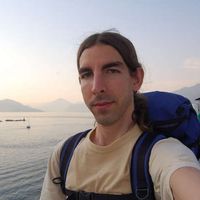
Not Accepting Guests
- Last login over 8 years ago
Join Couchsurfing to see Nathaniel’s full profile.
Overview
About Me
CURRENT MISSION
To get to Mercer Island to play cello in my friend's wedding ceremony
ABOUT ME
I'm a village-bred kid lost in the big city. My search for meaningful human relationships guided me to couch surfing. I am respectful, responsible, motivated, resourceful quiet, and contemplative. I make an effort to be considerate of others in everything I do, thinking of those I impact both directly and indirectly. I am clean and I always try to leave places and things in the condition in which I found them or better. My friendships are deep and lasting. I am a cellist, a contemplative Christian, a software developer, a cyclist, a morning person, and a bit of a do-it-yourself-er.
PHILOSOPHY
The point of my life is to be created more by God than by my own initiative. I seek submission to the divine will. When I find God's will and follow it, I am moving toward my potential.
Why I’m on Couchsurfing
COUCHSURFING EXPERIENCE
None so far. Looking forward to it!
Interests
- Spirituality and religion
- Music, especially classical
- Computers and computer networks
- The sun
- Cooking
Music, Movies, and Books
I'm still in awe of the classics: Bach, Haydn, Mozart, Brahms, Mendelssohn, Schubert, Schumann, Tchaikovsky, Faure, Mahler, and friends. I also love a lot of music from the past 120 years, like Debussy, Britten, Reich, Glass, Tavener, Part, and Messiaen.
I love jazz as well; particularly small instrumental combos. And I have definitely enjoyed a share of pop/rock music and metal.
One Amazing Thing I’ve Done
- Performing Mahler's fourth symphony with the National Youth Orchestra of Canada
- Sailing a catamaran built by my father and me
- Living on a farm in rural Andean Ecuador with no electricity for one month
Teach, Learn, Share
The RAID (Redundant Array of Inexpensive Disks) approach to reliably and performantly storing data redundantly to safeguard against disk failure:
Using RAID, data can be recovered in the case of disk failure without complete 1-to-1 redundancy. Parity is the basic idea used in RAID. Parity uses one extra bit for a given number of actual data bits to record the sum of the bits so that if one of the bits is corrupted in storage or transmission, this can be detected and its original value can be deduced based on the parity bit.
As an example, if you have five disks, you distribute your writes across disks A, B, C, and D. For each "stripe" of four bits across those data disks, you record on disk E one corresponding check bit which indicates whether the sum of those bits was even or odd. Say it was even, so you write a 0. Now, when disk C fails, you sum the bits in the stripe from disks A, B, and D. If the sum is odd, you know you disk C must have had a 1. If the sum is even, you know disk C must have had a 0.
In this simple case, you can lose any one disk at a time without losing data. This is like having two copies of the data (one to use in case you lose the other), but you're using 80% of the space available on your disks for live data rather than only 50%. There are quite a few things you can do with the redundancy scheme, the size of the stripe, and the number of disks to affect the reliability, performance, and disk space cost of the system.
Cool, eh?